
Contemporary minimalism has evolved.
After a period dominated by cold abstraction and extreme neutrality, a new architectural language is emerging. It remains essential, yet it is more sensorial, more human and more timeless.
Within this context, alabaster has become a key material in shaping what many architects define as warm minimalism.
This is not about adding texture for the sake of it, nor introducing decorative gestures. It is about working with matter and light to create spaces perceived in silence. Spaces without stridency, yet charged with sensory depth.
What We Understand Today as Warm Minimalism
Warm minimalism does not abandon formal clarity or the reduction of elements. It strengthens them.
What it introduces is a fundamental variable: the user’s experience.
In this architectural approach:
- Light is not uniform. It is nuanced.
- Materials are not neutral. They are honest.
- Surfaces do not seek to disappear. They accompany.
Space is defined through the relationship between a few carefully selected elements. Within that selection, materiality becomes decisive.
For architects working with natural stone, this means choosing materials not only for their appearance, but for how they transform light and atmosphere.
Silent Architecture: When Material Does Not Compete
We speak of silent architecture when materials do not seek immediate protagonism. They do not demand attention. They sustain the space.
Alabaster integrates naturally into this design philosophy because:
- It does not reflect light aggressively.
- It does not create harsh contrasts.
- It does not impose a dominant visual reading.
Its presence is constant yet serene. It adds depth without visual noise.
In projects where light becomes an architectural tool rather than a decorative effect, the behavior of the material is critical. High-quality alabaster, carefully selected and technically supported, ensures consistency, safety and precision in execution.
Why Alabaster Works in Contemporary Minimalism
1. Because It Adds Warmth Without Losing Sobriety
Alabaster is a natural stone with soft tonalities, organic veining and subtle texture. Unlike other materials frequently used in minimalist architecture, it does not cool the space.
It introduces warmth that does not depend on color or ornament, but on its luminous and material behavior.
When sourced and processed with technical rigor, alabaster allows architecture to remain restrained while being emotionally resonant. The result is a material that elevates the space without overpowering it.
2. Because It Works With Light, Not Against It
In minimalist projects, light is often controlled, indirect and precise.
Alabaster does not interfere with this intention. It amplifies it.
Its natural translucency allows:
- Homogeneous light diffusion
- The elimination of harsh shadows
- Seamless transitions between spaces without glare
This makes it particularly suitable for:
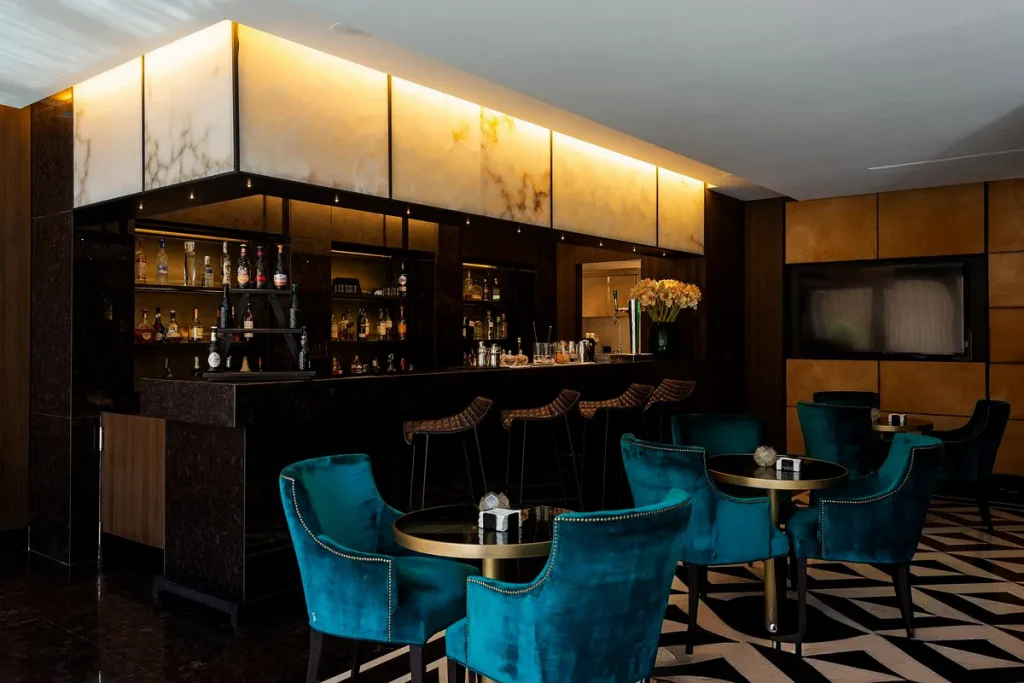
- Backlit vertical planes
- Architectural partitions
- Large-scale surfaces where light defines the atmosphere
For large-format applications, technical expertise in extraction, cutting and installation becomes essential. Working with alabaster at architectural scale requires experience, control of origin and understanding of the material’s structural behavior.
3. Because It Introduces Materiality Without Losing Abstraction
One of minimalism’s challenges is avoiding excessive abstraction or impersonal coldness.
Alabaster resolves this balance naturally.
Each piece is unique, with unrepeatable veining. Yet its global reading remains calm and continuous. The individuality of each slab does not disrupt the coherence of the whole.
This balance between identity and restraint is what makes alabaster particularly aligned with contemporary architectural language.
Alabaster Compared to Other Minimalist Materials
Compared to common minimalist solutions:
- Exposed concrete is powerful but cold and visually dominant.
- Glass is lightweight but lacks material depth.
- Synthetic surfaces are uniform but deprived of the dimensional richness of natural matter.
Alabaster offers a singular alternative. It is a natural stone capable of integrating into contemporary architectural languages while preserving formal coherence and adding luminous depth.
Minimalism That Endures
Warm minimalism does not aim to impress at first glance. It seeks permanence.
It reveals itself over time, through use and through the changing light across the day.
Because of its geological origin and its intimate relationship with light, alabaster has become one of the materials that most accurately embodies this understanding of contemporary architecture.
At Arastone, working with alabaster means understanding its origin, its structural properties and its luminous potential. It means treating each slab not as a decorative surface, but as an architectural element.
In an architecture that aspires to be silent, precise and human, alabaster is not a gesture.
It is a design decision.